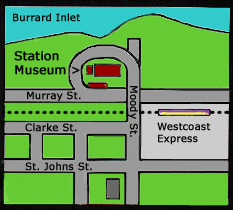
2734 Murray Street, Port Moody, BC, Canada
(604) 939-1648
Port Moody Station Museum Website

Friday, July 08, 2005

Canada Day

This year's Canada Day was the biggest day in the Port Moody Station Museum's history, with almost 4000 visitors. Three staff members and four volunteers took about 500 photographs.

Our Canada Day started at eight am, three hours before the festivities were to officially start. We had set up as much as we could the day before, hanging the Canadian flag bannerettes across from the Venosta railcar to Charlie's Shed then to the Station and across the Station Platform; dragging seven display cases into the Venosta for the war memorabilia display; draping pennants inside the Venosta; sweeping and vacuuming the entire Museum; and stringing up a line of flags to go across the parking lot.

Finally on Canada Day, we had less than three hours to get the Venosta to look like a WWII Victory Train.

The problem?

First of all, WWII Victory Trains were rather dull affairs.

Second, once we decided we wouldn't be that historically accurate, we needed to figure out how to string up the bunting on the Venosta without taping or nailing anything into our 1921 railcar. (After all, museums don't just display artefacts, they also conserve them.)

It took two staff members and three volunteers a long time, but finally it looked perfect:

Venosta as Victory Train

Then Western Command arrived:

Western Command Sign

At ten am sharp, World War II jeeps, trucks and a lone Harley pulled into our parking lot:

At 12:05 pm

Even before we opened, we had over 200 visitors.

Also at 12:05 pm

Who wouldn't want to be seen driving one of these?

At 12:43 pm

Another view of the Museum grounds. You'll note the tricolour half-fan on the Venosta, which was considerably easier to attach.

Venosta as Victory Train with the Vintage WWII CMP

It's thanks to Vince Hands of Western Command that we got such a fantastic display of vintage military vehicles. Here is Vince (on the right) with Robert Morrison.

Robert Morrison and Vince Hands

And we can't forget the driving force behind this year's display: Mr. Guy Black.

Guy Black with Guests of Honour

From left to right, we have WWII veteran June Moreau, Mayor Joe Trasolini, Guy Black and MLA Iain Black.

Guy is a local war historian. He and two others set up a display of medals, uniforms and other war memorabilia in the Venosta.

Western Command also set up a WWI tent outside the Venosta:

WWI Tent with Venosta

The front of the tent:

WWI Tent

Inside the tent:

Inside the WWI Tent 2

Another view of the inside of the tent:

Inside the WWI Tent

George Clark, another member of Western Command, brought his rope cannon and fired it off twice, once in the opening ceremony and then again during the official ceremony for our guests of honour.

1143 am firing the cannon

The countdown:

Waiting for the Cannon to Go Off

Then kaboom!

Ceremonial Cannon

After weeks of hard work, Museum staff finally got a chance to relax.

Here's our exhibits assistant:

Exhibits Assistant

Our Programs Assistant and Research Assistant:

Programs Assistant and Research Assistant

The Museum Assistant and Programs Assistant in a 1971 UN Jeep:

1971 UN Jeep with Museum Assistant and Programs Assistant

Then there was the WWII Harley:

Roberto Mossier on the Harley

Close-up of the Harley:

Harley Close-up

Another close-up:

Harley Close-up 2

Our Collections Assistant finally taking a break:

Collections Assistant with Roberto Mossier

Even the Mayor had to try it out:

Mayor Trasolini on the Harley

Luckily the rain held off until the very end:

At 12:41 pm

Tuesday, July 05, 2005

Abandoned Railroads

Thousands of miles of railroads have been abandoned in the United States, much of it in the last 30 years. All of these railroad lines have a history and a story.


Photos and the history behind these ghost lines here. Also, two listings for Canada, both in Winnipeg. Surely there must be more in Canada.

Sunday, July 03, 2005

Neighbourhood Detective

We've discovered someone's detective work on their neighbourhood in L.A.:

I’ve been obsessed all weekend with researching.....the roots of my neighborhood — tracing the people who lived in the various houses on my block over the past hundred years and finding out what happened to them after they left the hood.

.....The hours flew by as I studied the handwritten census forms from 1910, 1920, and 1930, along with the Social Security Death Index and World War I Draft Registration cards.

I discovered a fascinating mix of lawyers, doctors, tailors, real estate agents, orange growers, owners of gold mines, a silent movie actress, the lead saxophone player in Paul Whiteman’s orchestra, the rabbi who married Irving Thalberg and Norma Shearer, a famous architect of Craftsman houses and his one-year-old son who went on to become an Oscar-winning Art Director, along with countless people of all ages who did not work but were listed by the census workers as having "own income."


The rest of the entry is quite funny and has this funny part about someone in a yearbook:

[O]ne single-line entry immediately stood out to me: "Hyman Zarinsky: Has zest." Nothing else was mentioned, but then again, when you have zest, what else is there to say? I had to research Hyman, of course, and soon was able to piece together a dossier of his life which ended on October 6, 1980. But some things can’t be found in government documents. Did his wife Molly share the yearbook committee’s assessment of her husband’s zest?


As I've started researching our own local history for ghosts, disasters and the macabre to add to my Dark Side of Port Moody tours this October, I appreciate anyone's efforts in taking deeper interest in their neighbourhood. We're going to keep reading this blog for more developments in the author's historical detective hunt.

By Oana Capota

Canada Day Aftermath

Boy, were we sad to take down the Canada Day decorations.

Canada Day was the funnest we've ever had (and, as all special events at the Museum, extremely busy). About six vintage military vehicles came and the guys from Western Command set up a WWI tent alongside their other displays. They all set out as a convoy to pick up our guests of honour. Then they brought over a rope cannon that announced the start of the event and the arrival of our guests of honour.

We'll be posting pictures as soon as we upload them all.

Thanks to everyone who helped out - we couldn't have done it without you!

Wednesday, June 29, 2005

We're Going to be on TV!

Tasha Chiu from Shaw Cable's The Express came in this morning to do a special on us! You can see the program at the following times:

Wednesday Program:

Original: 6pm

Repeats: Wednesday 10pm

Thursday 2am, 6am, 8am, 10am, 2pm, 3pm, 6:30pm, 10:30pm

Friday 2:30am, 6:30am, 8:30am, 10:30am, 11:30am, 2:30pm, 3:30pm

Thank you to Tasha and her crew! And a special thanks, too, to Guy Black and Vince Hands who took time off work to show off part of our upcoming Year of the Veteran display.

Tuesday, June 28, 2005

Elementary School Tour of the Garden

Yesterday's group of grade two and threes got a tour of the CPR garden along with the rest of the Museum.

We took one group to the edge of the mint section and asked the kids to rub the plants. Then we told the kids to smell their fingers. They were amazed. "It smells like real mint - too bad real mint can't grow like this," said one little girl.

Then we guided the children to the peas. Each child got one pea off the plant and a couple asked for take-outs for their siblings.

The kids pointed out the "purple bell flowers." Everyone laughed at the name of the foxgloves. Foxgloves grow all over the Greater Vancouver region and we were surprised the kids had not heard this before.

Finally, our tour of the garden ended at the lemon balm with the same procedure that the kids went through at mint section of the garden.

Everything in the garden is now beautifully labelled with white markers stating each plant's name. Our wonderful exhibits assistant made these gorgeous little signs.

A lot of the garden, however, is not growing as well as it should: it has been an incredibly wet spring and now summer, and the slugs are making the most of it. Tom, our master gardener, took a shovel and decapitated all the big slugs he could find. Next he is going to make the "Sudden Death Slug Pub."

By Oana Capota

Wednesday, June 22, 2005

Renovation Day Again

We're rushing to get the Museum's Mailroom and Telegraph Room painted before the end of the week: we have two school tours coming in, along with Vancouver Paranormal and, of course, there is Canada Day Weekend next week.

First, we had to move everything from the Telegraph Room into the Station's Waiting Room:

Museum Renovation June 21, 2005

That's an old calculator you see in the foreground:

Museum Renovation June 21, 2005

Our Telegraph Room looks rather forlorn now that it's almost empty:

Museum Renovation June 21, 2005

Walking from the Telegraph Room to the Mailroom, here's our Exhibits Assistant:

Museum Renovation June 21, 2005

And here is the Mailroom with our Collections Assistant and Curator:

Museum Renovation June 21, 2005

It's a good thing the clay-based heritage paint we're using doesn't smell much.

Tuesday, June 21, 2005

1944 Dodge WC-52 Weapons Carrier

We got a picture of the 1944 Dodge WC-52 Weapons Carrier 3/4 ton:

Dodge WC

Update: This photograph is from the set of the Steven Spielberg film Taken. The movie took place in 1940s Roswell, hence the American uniforms.

Monday, June 20, 2005

Military Vehicle Display

It's been too long since we posted anything - it's a sign of how busy we've been here!

Canada Day is a week away. (Friday July 1 for those of not from this country.) Every Canada Day we have a big festival. This year will be bigger than ever as it is the Year of the Veteran.

It's been extremely hectic, what with finalizing bagpipe players, putting together a blockbuster veterans exhibit together with three local collectors, getting the decorations done up for our Victory Train, signing up three telegraphers to do demos, and getting an outdoor display of military vehicles.

Our parking lot, which we will close off to the public, will have five vehicles, almost all WWII-era:


Year 1945
Make Ford
Model GPW (JEEP)

with a Canadian WWII 10cwt trailer for a Jeep


Year WWII
Make Dodge
Model WC-52 Weapons Carrier 3/4 ton


Year 1971
Make Canadian U.N. M38A1
Model Willys Jeep

UN M38A1


Year 1942
Make Willys-Overland
Model MB

done up in the Canadian Black Watch markings

1942 Willys-Overland


Year 1944
Make Canadian C.M.P. (Canadian Military Pattern)
Model 15 cwt

1944 Canadian C.M.P. (Canadian Military Pattern)

We'll take lots of photos on Canada Day of the rest of the vehicles.

By Oana Capota

Thursday, May 26, 2005

Picture Rail

In preparation for the Port Moody Heritage Society's upcoming annual general meeting, we need to do some last minute changes to the Parlour and the Kitchen.

A few months ago we repainted these two rooms with period colours and we now change the displays on the Kitchen table and the piano "mantle" seasonally. Volunteer Linda Moncur changes the floral displays under the cloche on a weekly basis.

On Sunday, we are officially opening these two rooms to all the members of the society that runs the Museum. The last thing we need to do is to paint the picture rail - our new Exhibits Assistant went to work on painting it - and then hang it up, along with the pictures of John Murray Sr. and his wife, Jane Murray (whose two great grandsons visited the Museum this morning).

Well, that will be the second to last thing we need to do. We are also outfitting some cutlery (said to be a gift from Prime Minister John A. Macdonald) in a shadow box to decorate a Parlour wall.

You can see a close-up illustration of a picture rail here. The framed picture hangs on chains to the hook and the hook slips into the picture rail. The picture rail goes along the perimeter of the room, at about a foot under the ceiling.

An interesting idea we found while googling the illustration to which we linked, is a modern how-to on making a bulletin board picture rail.

By Oana Capota

Human Flower Project

The Human Flower Project published our article on CPR Gardens - read it here!

Ghost Sighting

We got a call from Vancouver Paranormal today and it seems like they've caught something on film.

They visited the Museum after hours one night and photographed the Station Platform. When the photo was developed, they saw an apparition of a lady with a hair bun.

Here is what the Station Platform looks like in daylight (albeit on a dark and dreary day):

Museum in the Autumn 4


By Oana Capota

Update on the CPR Heritage Garden

Tom Galinis, our volunteer master gardener, sent an update on our CPR Heritage Garden:

1. Have re-worked the compost bins, please do not add any more items to the compost in the small bin. This one is working fine and we now have to let it "ferment" to completion. The large compost bin has been split into two. If you are facing the Boathouse - the pile on the right side of the large compost box is about complete - it too must "ferment" to completion. So.....if you have stuff to add to the compost, please pile it up on the left side of the box. Also, should you add large stuff - it should be chopped up first before laying it in the composter.

2. A reminder that I have some seedlings for the garden. I have about 20 of the Stock; about the same in Elephant's Head Amaranth (this is a heritage flower), plus some Hyssop an old time herb used to flavour stews etc. I also have some sunflower seeds - not the dwarf ones, the tall ones.

3. In terms of veggies, the final count works out like this:

1 heritage pumpkin - "small sugar"
2 heritage squash -- "Hungarian naked seed"
3 cherry tomatoes - "red cherry"

Right now these are growing under lamps indoors; I will harden them off outdoors this week and we can plant them this coming weekend. Not sure if we can plant the pumpkin near the squash but guess can think of something. As for the watermelon and cucumber and tomato, if they are not wanted at the garden, that's fine; I can always give them away.

4. I have saved up a few milk cartons to put around these new plants to try and frustrate the slugs. Perhaps you could ask if others can save them up as well. For the squash, I will look at getting one of those copper barriers.

5. A suggestion for a job: sort through all the seeds that are in the shed and the station. Anything that is older than 3 years should be thrown out; the rest put into properly labelled containers (something that won't retain moisture) and then put them into refrigerated storage. Keeping the seeds cool and away from hot temperatures will keep them viable for a longer time. I'm thinking that some of these seeds are not viable because they are too stressed from the storage at the Station. It is said that the best place for seeds is the freezer, keeps them from deteriorating.

6. Perhaps this weekend, if I get time, I have some fishnet for the sweet peas and will hang it up around the sweet pea area. Should give them support to grow on. A reminder that when growing sweet peas, one must keep removing the spent blooms otherwise they will not keep blooming. If we let them go to seed, they will stop blooming.

By Tom Galinis

Tuesday, May 24, 2005

Burkeville

Via the History of Metropolitan Vancouver website (and this via Darren Barefoot), we learned about Burkeville, a small neighbourhood of Boeing company housing:

Burkeville was laid out and built by the federal government during the Second World War to provide 328 houses for workers employed at the Boeing Aircraft plant. It was named for Stanley Burke, president of Boeing. The streets are named after airplane manufacturers. The plain, no-frills dwellings came in several standard sizes. Most have been altered to fit the needs of two generations of residents. After the War, Boeing sold the houses to returning veterans. The tightly-knit community, already encircled by airport uses, is currently threatened by the intended further expansion of roads and runways.” Ironically, the “plain, no-frills dwellings” were designed by McCarter and Nairne, who gave us the Marine Building. The name of the development was chosen in a competition among Boeing employees.


In Port Moody, we also have some company housing remaining from the Ioco (or Imperial Oil Company) Townsite so learning of this other company neighbourhood is something up our alley.

A note on the History of Metropolitan Vancouver website and book's author: on April 3, the Museum presented a talk by Chuck Davis, who thrilled the audience with stories and photographs of old-time Vancouver. Most astonishing was the first mechanized ambulance in the city. It ran over and killed an American tourist on its test run.

By Oana Capota

Summer Hours

Every year on Victoria Day, the Port Moody Station Museum switches over to summer hours (10 am to 5 pm) from our off-seasion hours (12 noon to 4 pm). This year, Victoria Day fell on May 23 and today we wiped off our blackboard sign to update our information.

Sunday, May 15, 2005

Filming Begins

The kids from the Vancouver Film School arrived. They are staying overnight to shoot their movie in the Venosta railcar. The plan is to do half of the filming tonight and the other half tomorrow night, when traffic doesn't disturb them.

The Venosta in the Autumn 2

"If you have any questions, just ask before I leave."

They returned a few minutes later to ask where the bathrooms were.

By Oana Capota

Photo Friday: Space

For this week's Photo Friday challenge, Space, we've chosen to submit a photograph from this afternoon's antique appraisal show: here is the junction between an antique mechanized horse, the train tracks and the mats leading to the Museum's entrance.

Horse Antique Appraisals May 15, 2005

Dating from the 1930s, this horse is similar to the kiddie ones we find today in malls. (We'll post the rest of our photos later.)

By Oana Capota

Morse Code Beats Text Messaging

At the Port Moody Station Museum we have a few telegraph machines. Every Canada Day we bring in some telegraphers from the Morse Telegraph Club to demonstrate their skills.

On Friday, these telegraphers went on to the Tonight Show with Jay Leno to recreate a competition that took place in Sydney, between a 92-year-old telegrapher and a 13-year-old cell phone whiz kid. You can view the video of Chip Margelli K7JA and Ken Miller K6CTW here. (A little bit about the background of the Jay Leno competition reported here.)

You can also read about the original competition. Via Mirabilis, we found this (originally reported at the Times Online):

Thnk ur gr8 @ txt msgng? You may think you're saving time cutting out all those pesky vowels when sending text messages to your buddies, but Gordon Hill, a 93-year-old Morse code specialist, just might prove you wrong.

In a competition staged by an Australian museum, Hill, a telegraph operator since 1927, was pitted against 13-year-old Brittany Devlin in a battle of the messengers. Hill was armed with nearly a lifetime of experience using Morse code; Devlin, with two years of text messaging experience and a slew of slang popular with chronic texters. A sentence was chosen at random from a teen magazine, and both contestants had to transmit the message as quickly as possible.

.....Hill transmitted the complete message in 90 seconds, while Devlin used texting shorthand and finished sending her abbreviated message a full 18 seconds later. Hill then handedly defeated three other young foes armed with their mobile phones.

The Powerhouse Museum in Sydney, where the original competition took place, is a science-and-technology museum. Housed in the 1899-1902 Ultimo power station which closed in 1963, the museum took over the station in 1979, opening its doors in March 1988.

By Oana Capota

Friday, May 13, 2005

Railway Garden in Port McNicoll

Tay Township, 142 km north of Toronto (and said to be named after one of Lady Sarah Maitland's lap dogs), includes Port McNicoll.

In 1912, the CPR connected Port McNicoll to Orillia in the southeast and transferred its steamships (luxurious twin ships Assiniboia and Keewatin, and freight ships Manitoba, Alberta, and Athabaska) from the steeper and more distant Owen Sound. Port McNicoll, named after a vice-president of the CPR, became the "Chicago of the North" once the CPR moved its grain routes wholly into Canada.

In the 1920s, tourists replaced immigrants as the majority of passengers on the CPR's fleet and many of these tourists stopped to admire Port McNicoll's railway gardens.

(After the Keewatin retired from service November 29, 1965, it went to Saugatuck-Douglas, Michigan on June 27, 1967 to become the Keewatin Maritime Museum. The rest of the ships succumbed to fire or the scrap heap after the Depression.)

Richard Kay, who established Port McNicoll's CPR Gardens, and John Bell worked on the gardens together until Kay's death. Bell's greenhouses, "heated with steam from the CPR’s laundry," supplied the sunflowers, hollyhocks, sweet William and geraniums:

Work began on the flowerbeds in March of each year...They were watered and manicured each night by six men, and were a perfect place for CPR passengers to pause while waiting for their ships to board.

By Oana Capota

Wednesday, May 11, 2005

Filming, Newsletter & Other Tidbits

Today the Museum had its bimonthly mail-out. After a few days of assigning articles, clutching at words, then laying them out and trying to get everything to fit onto eight pages, our newsletter, the Station Telegram, was ready for printing. Then came the easy part: stapling, folding, inserting into enevelopes, stamping, and sealing. All members of the Port Moody Heritage Society get a copy.

That's the normal part of our schedule here at the Museum.

Today, however, we also had a small army of film students from the Vancouver School of Film check out our Venosta.

Three representatives dropped by to scout the place last week. This morning, they brought the rest of their crew and a couple instructors to see if the place is, indeed, perfect.

After measuring tables and windows, and examining our electrical situation, they decreed that we will be a location in their film.

We went back to stapling and folding after that.

Also, the Tri-City News posted our antique appraisals show on their website. Like the Antiques Roadshow on tv, antique owners bring in their treasures to find out the story behind them and their monetary value. Also from the Tri-City News, there is our call for new board members.

By Oana Capota

Tuesday, May 10, 2005

Mother's Day at the Museum

Our Mother's Day Tea on the Train was a great success. Many visitors came from all over the Lower Mainland to drink tea on our 1921 railcar, the Venosta.

One visitor, in particular, proved extremely memorable. An older gentleman, he lived across the street from where the Museum now sits during the Thirties and the Forties.

He remembers that an orchard occupied this land in those days. All along Murray Street, where the autobody shops, pleasure boat stores, pasta factories and other warehouses now stand, were Chinese gardens. Just to the northwest of the Museum (in the Boathouse parking lot) was a bunkhouse for the Chinese workers and they grew carrots and potatoes. Cows, too, strolled through this area.

When the bunkhouse burned down, the Chinese went to stay in the Tourist Hotel until they got a new building. The white children of Port Moody, however, went to dig through the ashes of the bunkhouse. They found a few coins fused together from the heat and sawed them apart, taking them to the bank to trade them in for proper nickels, which bought an ice cream in those days.

There were also Japanese boats all along the shores and, when the Japanese were interred in 1942, every school child cried for their lost friends. Yet, many children did venture onto the confiscated boats to try the sake left behind.

Then there is Pigeon Cove at the eastern end of the Inlet: its namesake pigeons dreaded the annual September Pigeon Shoot.

Chief Mackie also figured in our visitor's stories. Our visitor told us he spent four hours in the City Hall jail cell for playing hooky.

Ah! The good old days!

By Oana Capota

Sunday, May 08, 2005

Victory Trains

While most people are celebrating Mother's Day today, we shouldn't forget that it is also the sixtieth VE Day, the day when World War II ended in Europe.

The Port Moody Station Museum has in its collection a local newspaper bearing this pivotal date, with pictures of the smiling leaders of the victorious states (including Chiang Kai-shek, the only non-caucasian of the bunch). Today the focus is instead on mothers and getting ready for our busiest tea of the year.

Yet Russia is today commemmorating VE Day with Victory Trains.

The idea came from Moscow Mayor Yury Luzhkov; on May 4, a 20-car WWII-style train began travelling from Brest, which the Nazis attacked on June 22, 1941 at the beginning of their assault on the Soviet Union. The train is actually on its way back to Russia after making its way to Berlin on April 15 with 70 veterans as the Train of Remembrance, and was part of the Grand Expedition of Remembrance for young people.

From Brest, the Victory Train carried 450 veterans, stopping to place wreaths on the graves of unknown soldiers in Minsk, Orsha, Smolensk, Gagarin and Borodino.

Two other Victory Trains operated in Russia's far east, leaving Khabarovsk on April 6 and April 11 respectively. Veterans onboard and in stations along the way were treated to gifts from rail officials and performances by amateur song and dance groups.

By Oana Capota

Saturday, May 07, 2005

New Acquisition: Calling Card Case

Visiting Card Case

A beautiful silver-plated card case (above) was just donated to the Museum by Marjorie Almstrom.

According to Almstrom, it belonged to her sister, Ethel Carter, who came to Port Moody from England in 1911 or 1912. She received the case as a gift on her 21st birthday in 1923.

In the early 1920s, the cases were used to hold printed calling cards by the ladies of the "social elite." It was customary to hold gatherings where callers would leave their calling cards for the ladies. If a lady was unable to attend the gathering she could send her card with someone else. The ladies would carry these cases which contained their own cards as well as those they received from the callers.

This particular case has flower embossing on each side as well as a silver chain and leather interior. The name of the owner of the case is also engraved at the top of the case near the clasp. The case contained a photo of Ethel’s husband who served in WWI, as well as her $3.00 membership to the Port Moody Amateur Athletic Association of the years 1922-23.


By Jennifer Bergeron

Tintex Stocking Dye

In our Mother's Day display, we have a small box of Tintex Stocking Dye. We got curious about its background and its exact date.

Tintex Stocking Dye (Front)

The dye is for nylon, rayon, cotton, lisle (a type of cotton thread), silk and wool. Now, rayon (or artificial silk or wood silk) dates from the Nineteenth Century and nylon's invention was in 1935 (with nylon stockings first going on sale on May 15, 1940). Therefore our box dates from after 1940. The original name of the dye, Victory Beige, has been stamped out and replaced with Bronzeskin. Like, the victory gardens of the war, the idea of Victory Beige is also suspect...a Google search of Victory Beige turned up nothing linking it to WWII (at least nothing in English).

(Interestingly, the tornado in the film version of the Wizard of Oz was made of nylon. Much more on nylon here.)

When it comes to Tintex, things get murky. Today there is a Tintex dye manufacturer in Australia and an industrial paint Tintex company of more international scope. We did find the modern-day descendant of our Tintex Stocking Dye at Manhattan Wardrobe Supply. And we also found out that you can still dye your nylons, as long as they aren't coated with Teflon.

The back of our box of Tintex Stocking Dye:

Tintex Stocking Dye (Back)

Tintext STOCKING DYE

USES
1.For restoring colour to faded stockings.
2.For giving a new fashionable colour to stockings.
3.For making odd stockings a matching colour.
4.For Keeping stocking colour fresh.

DIRECTIONS
This package is for stocking made of Nylon, rayon, cotton, silk, wool, lisle and mixtures. Wash stockings as usual and rinse well. Dissolve a little Tintex in sufficient warm water to cover the stocking completely. Dip stocking in this solution, turning and moving about until the desired shade is attained. To get a deeper shade, remove stockings, dissolve more Tintex and continue as before. Rinse thoroughly in cold water. Dry in the usual way.

NOTE: TO give a new different colour to stockings, or to re-dye odd stockings to a matching colour, first use Tintex Colour Remover. This takes out sufficient old colour. Then Tintex your stockings to colour desired. When removing colour from stockings, the Colour Remover bath should be well under the boil.

Made in U.S.A.

Park & Tilford

New York

Est.1840

Distributors


Unfortunately, Park & Tilford mostly leads to North Vancouver's shopping mall. We found a number of perfumes from Park & Tilford, the distributors of our Tintex Stocking Dye, but no history on them.

Whatever the story is behind our Stocking Dye, the company at the time had a few other products up its sleeve. From the side of our box:

6 Products for ALL Home Tinting and Dyeing
1.Tintex Gray Box - Tints and dyes cottons silk, linen, wool rayon
2. Tintex Blue Box - Tints the silk – lace remains white
3.Tintex Curtain Ecru - The perfect curtain dye
4.Tintex Stocking Dyes - For faded or mis-mated stockings of Nylon, rayon, silk , cotton, wool or lisle.
5.Tintex Colour Remover - Removes dyes from fabrics
6.Whitex Wonder Bluing - For all white material.


By Oana Capota

Thursday, May 05, 2005

Florals, Week of May 5-12

Linda Moncur Florals

Linda's floral arrangement this week used the azaleas from the CPR heritage garden, as well as the columbines from the entrance to the Museum, and a few sprigs of the perennial geraniums.

Here's a close-up of a columbine still in the garden:

Linda Moncur Florals 2

By Oana Capota

Photo Friday: Fancy

Trunks

For this week's Photo Friday challenge, "Fancy," we've chosen our travelling trunks from the Freight Shed.

We already wrote a little about them as the site of a possible haunting.

We want to point out the two back chests with the rounded tops: they are the fancy ones.

In the past, the upper classes preferred this luggage. No one could stack their suitcases on top of these trunks, ensuring that even the luggage of the upper classes remained upper class.

By Oana Capota

Thursday, April 14, 2005

The BC Ghosts & Hauntings Research Society Comes for a Visit

The Museum's staff members* have a feeling that there is something - or someone - else in the Station.

We've had doorknobs rattling, footsteps in rooms where no one can be seen, doors swinging open of their own accord, weird electrical issues where the lights switch on by themselves, banging noises as though someone is trapped in the basement...

We haven't seen an apparition yet and we disregard a teen volunteer's story of the one ghost sighting.

Just in case, we invited the BC Ghosts & Hauntings Research Society to visit and see what they think.

Visit from the BC Ghosts & Hauntings Research Society
Above: Representatives from the BC Ghosts & Hauntings Research Society: from left to right: Heather Anderson, Tracey Gambin and Christina Carr.

Below: Tracey Gambin set up her video camera in the Station's Kitchen, facing the Parlour.
Tracey Gambin of BC GHRS

Until the CPR discontinued its passenger service in 1976, this train station had a live-in unit for the stationmaster and his family; the Kitchen and the Parlour, along with the four bedrooms upstairs, made up the private quarters of the stationmasters from 1905 onwards.

Between the Kitchen and the Parlour, there is now a door leading onto the basement stairs. It is this door that once opened on its own.

The Ghosts & Hauntings Research Society pointed out that the door is of light wood and drafts can push doors open. Thus the explanation for the door's mysterious opening might be more prosaic.

Nevertheless, Tracey pointed the camera to the space directly in front of the basement door.

The Parlour, itself, might also hold some secret. Some of us have been in the basement and, when we hear footsteps above and rush upstairs, we find that the Parlour is empty.

Christina Carr of BC GHRS
Above: Christina Carr of the BC Ghosts & Hauntings Research Society films our baggage cart, where unusual knocking noises were heard.

Another location in the Museum where we've experienced interesting phenomena is the former Freight Shed of the Station. This giant room takes up about a third of the Museum's main floor. We use it to display artefacts about the development of Port Moody, from its prehistoric origins to its industrial peak. To celebrate our railway heritage (we're the original terminus of the CPR and Canada's first scheduled trans-continental train ended its journey here), we have a number of railway displays, including a baggage cart loaded with Nineteenth and early Twentieth Century suitcases and trunks.

One afternoon last fall, when a previous stationmaster's wife visited, five of us heard a sound from inside one of the suitcases. It could have been the rattling from a passing train, yet for the next few minutes we all had the feeling that someone knocked on the side of the suitcase, as if that someone was at a door and trying to get in.

We might here note that between the Christina's video camera and the baggage cart, is the bell from the train crash of '13 that killed five, a story we'll save for another day.

The BC Ghosts & Hauntings Research Society also wanted to examine the basement.

We try not to think about it but there is no getting around that basements, particularly ours, are creepy.

We have a volunteer who comes regularly to tend the 1910-1912 CPR Garden. He starts early in the morning, and one afternoon he asked us if we had ghosts in the building. We laughed but mentioned our experiences. The volunteer told us what happened that morning:

Before any staff members came that day, he worked behind the Museum where two doors lead to the basement. From inside, something was banging on the doors, trying frantically to get out. No cars or trains went by, he ruled out this as an explanation. The doors were locked, too, so the volunteer could not go inside to investigate.

Between the two outer doors is an interior door. We wedged this door open and Christina placed her tape recorder there to see if it would pick up anything unusual from either of the two other doors. The interior door spat out the wedge and slammed onto the tape recorder. We set up everything again and made sure the door stayed open.

Tape Recorder in Haunted Doorway

After about an hour or two of recording (with everyone far away from the devices), Heather, Tracey and Christina packed up their gear to go into the next step: reviewing the two videos and the tape recorder to see if anything odd appeared or made a sound.


*Except for the Curator. He is adamant that we are not haunted.

By Oana Capota

Wednesday, April 13, 2005

Florals, Week of April 12-18

Linda Florals Anemone & Rhododendron

Every week for the last year floral artist and volunteer gardener, Linda Moncur, prepared a floral arrangement for the Museum. Now that our CPR 1910-1912-style garden is blooming, Linda can use our very own anemones and rhododendrons, as pictured above.

We removed the cloche that covers the arrangement for the photograph; the cloche prevents insects that may be on the plants from invading the Museum's collection.

By Oana Capota

Monday, April 11, 2005

Welcome!

Port Moody is the original terminus of the Canadian Pacific Railway and the Port Moody Station Museum, run by the Port Moody Heritage Society, promotes increased awareness and knowledge of Port Moody's heritage and history.

Come back here every day to get a behind-the-scenes look at what happens at a community museum. We're a small museum but there is a lot that goes on here: an oral history project that started in the seventies, monthly special events from murder mysteries to antique appraisals to haunted tours, a volunteer-run 1910-1912 style CPR Heritage Garden program, changing exhibits and more. We'll also write about the history of Port Moody, the CPR and the history of the Greater Vancouver area as it relates to our city.

The 1905 Canadian Pacific Railway Company station that houses the Port Moody Station Museum was actually the second station in Port Moody. Moved twice (in 1945 and 1978), the reputedly haunted station shares its grounds with the Heritage Garden, a 1921 sleeper car, the Venosta, a log roller and a number of handcars. You can read more about the Museum at our main site.

This is actually the second blog of the Port Moody Station Museum - we started a trial version in the summer of 2004 (now defunct) which got rave reviews after we erased it. We had no idea that anyone was reading when we got rid of our first blog; we promise to keep this one going.

We welcome all feedback from visitors: please add your comments in the commenting link that appears below each post or, for more general questions, please email us.

Thank you for reading and we hope to see you soon at the Museum!

By Oana Capota

Sunday, September 05, 2004

Award-Winning Radish

We got third place in the Weird Vegetable Contest.

Our entry: