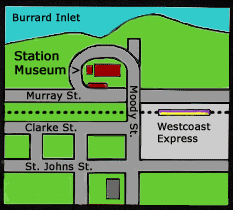
2734 Murray Street, Port Moody, BC, Canada
(604) 939-1648
Port Moody Station Museum Website

Thursday, January 26, 2006

VFS Location?

A group of Vancouver Film School scouts arrived in the rain today to check out the Venosta train car for the film they are making. They snapped digital pictures and measured and imagined. One guy had very fashionable jeans that had been "distressed" and patched, it seemed fitting for him to wear antiqued denim. They paused at many angles to determine how useful the views from the windows could be. In the end it seemed like the two berths that the museum has restored will be the most useful locations.

Promises were made all around, and shooting times are to be determined. It would seem that our train car will make into more than one student film! They seem like a good bunch of dedicated filmmakers. All young and burbling with potential.

Oh yes the film is set in the late 1880s and although our car was built in the 1920s it seems to be a satisfactory approximation. Their subject is the horror-filled days of a certain American writer's final months, full of intrigue, nasty disease and general decay. Spooky...

By Caelan Griffiths

Thursday, January 19, 2006

Vancouver Heritage Foundation $2000 Grants

From Kitsilano.ca:
If you own a heritage home in Vancouver, be sure to check out the Vancouver Heritage Foundation's True Colours campaign. They're offering five $2,000 grants plus complementary Benjamin Moore paint to Vancouver houses that are designated as heritage.
We went to the Vancouver Heritage Foundation site to see with our own eyes and there it was:
The first colour card of its kind in Canada, this palette is based on research data gathered by the scraping and colour matching on over 50 Vancouver homes.
The Historical Vancouver True Colours palette costs $1 at Lower Mainland Benjamin Moore stores.

Port Moody Sketches

Just for fun, I searched ebay for "Port Moody". Surprisingly, there is a business in California selling the free pins distributed by the city for $3 US plus the same amount in shipping and handling. Also, from the United Kingdom, there is a print store selling woodcuts from an 1883 newspaper showing scenes of Port Moody and the Fraser River. As long as the auction is going the link to the photo is here.

The woodcut featuring Port Moody is the presumably the second from the top and is captioned: "Port Moody - the present terminal of the Canadian Pacific Railway".

By Caelan Griffiths

This Week at the Museum

  • We sold out last t-shirt. It sat alone in the giftshop since 2004, when the penultimate t-shirt went its merry way. We should've taken a photo of it.
  • The Museum's newsletter, the Station Telegram, is on its own merry way. We still have a few we need to fold and stick into envelopes. For those of you who aren't members, here's why you should be members: we have an excerpt from a historical newspaper about the dynamiting of pioneer John Murray's house, highlights on three of the artefacts hidden in our vaults and some photos not on display at the Museum. Just go to our main website, download a membership form and send it to us with $20.
  • We discovered that Major J.S. Matthews lived and worked in Port Moody for many years.
  • We discovered the link between the Murrays and the Ems.
  • We discovered the possible date of Tom "Gunnysack" Riley's arrest for nude sunbathing. Could it be 1933?
  • The compost bin is full. "We may have to take it out even though it's freakin' freezing," says the Collections Assistant.
  • Oh, and we just got a call about one of the artifacts featured in our newsletter. It might be an early electric shock device. The Collections Assistant will start looking up medical devices. That was fast. We just mailed off our first batch of newsletters yesterday at 4 PM.

Friday, January 13, 2006

Early Childhood Centres in Port Moody

Question: I am a Montessori teacher and am currently taking my last few courses to complete my early childhood education certificate. I am trying to find out the history of ECE in Port Moody. Who ran the first daycare, or where was it and what year did it open? I would be grateful for any information that you may have on the history of early childhood centres in Port Moody.

Answer: Your question is a bit of a stumper. None of us have come across references to this yet. I'll remind everyone here to be on the lookout for this information during their work. It might take a while, perhaps after you get your certificate. But we'll try to find some information - this definitely is something on which we need more information.

Where Did the Venosta's Name Come From?

Question: I grew up in Venosta, Quebec which is North from Hull Quebec along the Gatineau River. I would like to know how this railway car go its name.

Answer: We always tell people that we guess the Venosta to have been named for your Venosta. Unfortunately we don't know for sure (it could have been named for the Venosta in Italy).

In the last few months since your email, all we've been able to uncover is that the Venosta's real name is the Glen Otter, not the Glen Atha as we were initially told. We were able to dig up an old plan for the railcar which elucidated this point.

The problem is, we are still no closer to finding out where the name really came from. We'll continue to look around and will post it here if we do find the answer.

Chinese Bunkhouse Update

Question: I would like to know what year the Chinese bunkhouse was demolished (by fire?)? Does the Museum have any photos of the bunkhouse? I don’t remember seeing any when I visited recently. Nice blog.

Answer: So you remember the Chinese bunkhouse sometime in the period of 1950-1971. That's great! It'll help us cross off the fifties in our search.

We've been trying to dig up information on the Chinese bunkhouse for months and unfortunately, we're still no closer to an answer.

Most of our info is from oral history interviews and a few artefacts; as this museum, like so many others, started out with the efforts of well-meaning volunteers, a lot of our information has not been properly documented. Other information is all anecdotes in books or letters, with no names or dates.

We do have an intern making a database of our newspaper holdings, working her way back from 1983. Hopefully we'll dig up something on the fire in the early newspapers.

We don't have photos of the Chinese bunkhouse, nor of the second one. We do have some information as to why there were two bunkhouses: according to A Cedar Saga by W. Guy Flavelle, the Flavelle Mill workers belonged to one of two "tongs," requiring two bunkhouses. One was the bunkhouse just off Murray Street near the Museum's present-day location and the other was closer to the centre of town, off of Clarke and Queen Streets, near a Chinese laundry and a Chinese boarding house.

Thank you very much for reading our blog.

Sincerely,

The Museum Assistant

John Murray Sr. Descendants

Question: Does anyone here know of any descendants of John and Jane Murray? In the Vancouver area or elsewhere ?

Answer: The Murrays had seven children:
  • Hugh
  • John Jr.
  • William
  • Henry (who died as an infant)
  • Sarah (who married a William Black Kyle after whom a prominent street in Port Moody is named)
  • Mary Jane (who married Charles McDonough in 1882 and moved to Nanaimo)
  • and Annie (who married George Ems in 1885 and moved to Point Grey)
Hugh, William, Henry, Mary and Sarah all have streets in Port Moody named after them, as well as mom Jane Murray and St. Johns Street, after either the senior Murray or the junior Murray. The reason they are all immortalized on Port Moody's maps is because of John Jr.'s influence: he was on the 1882 surveying party that subdivided the lots prior to the arrival of the first transcontinental train across Canada.

None of the other Murrays have contacted us; up until today we were aware only that John Murray Jr. stayed around and that he was a bachelor his whole life. This morning, however, I found an oral history interview in our collection that purports that John Jr. was indeed married and lived with his wife on Clarke Street. This contradictory information will take some time to sort out, provided we can find the records.

There is somewhat more information on the Murrays in the Early History of Port Moody by D. M. Norton. You can order this book from the Port Moody Public Library through the interlibrary system, buy it from the Museum ($15) or directly from the publisher. You can also see portraits of the senior Murrays as well as John Jr. at the Museum.

Sincerely,

The Museum Assistant

Thursday, January 12, 2006

Oral History Project Update

This morning, almost at opening, a volunteer came in to get more oral history interview CDs. She asked for about five CDs this time, as it didn't her long to get the first one done.

Since all our interviews are accessible only on CD and the contents known only to the interviewer and the interviewee, listening to the hundreds of interviews we've amassed during this 30-year-plus project is a daunting task. Plus, we're still adding interviews to the mix.

In the summer of 2004, we put out an ad for transciption volunteers in the local newspapers. Luckily, our two local papers, the Tri-City News and the Now, are extremely supportive and have aired our ads for over a year now. This has brought us a number of volunteers to take on the time-consuming and difficult job of writing down every single word on the CDs.

We're extremely grateful to these volunteers who are laying down the foundation of future Port Moody Station Museum projects. Already, we're matching oral history interviews to topics on the internment of the Japanese during WWII with a display on the Japanese presence in early Port Moody.

However, not every volunteer who comes to us has the stomach for transcribing. So when this morning's volunteer approached us for such a position, we suggested that she listen to the interviews and provide us with topical notes on what took place during the interview.

For example, with our new notes on her completed CD, we know about a "Port Moody hospital" that burned down on Clarke Street. With these notes, future researchers will be one step closer to finding that information.

We also have another great new volunteer who has done follow-up research on another interview and will meet one more time with the interviewee to flesh out the previous interview and nail down some dates.

Plus, the darned oral history transcription database needs tweaking. That's not so exciting but it needs to be done. *Sigh*

Overheard

The Museum Assistant, from the top of the stairs, heard the Collections Assistant's voice and then a much older woman's voice and a snippet of a conversation that started "naked Hungarian..."

Luckily, the Museum Assistant, despite not hearing the rest of the conversation, knew they were talking about the Hungarian naked seeded squash, one of the heritage varieties we grow in the CPR Heritage Garden.

Kim Jong-il's Train

From the Khaleej Times Online (from the United Arab Emirates), we hear once again of the North Korean leader's armoured train: "the reclusive leader, who has ruled his nation since his father’s death in 1994, rarely travels abroad, and when he does so, he refuses to fly, preferring instead to travel by a special armoured train."

No pictures of this mystery train? Dang!

Well, maybe one day it will be in a museum...

Good News and Bad News

The big news last night was that the Vancouver Maritime Museum is moving from Kits Point to land donated by the City of North Vancouver. Hold on! It's only in the planning stages. The plan needs about another $30 million to go through.

Then there is the fact that the Maritime Museum's collections belong to the City of Vancouver: "the museum is proposing a careful examination of the many internationally, nationally and regionally significant artifacts and holdings that could be loaned to the new centre," says Executive Director James Delgado in a press release.

Meanwhile, at the Manitoba Museum, fourteen employees will be laid off as that museum restructures. The Museum may eventually re-hire eight of those people when new positions are created. The museum currently has 75 staff members and a $5.5 million budget.

With the sad news that Victoria's Canadiana Costume Museum and Archives of British Columbia went out of existence on December 31, it seemed as if Canadian museums got off to a rocky start in 2006.

The Canadiana Costume Museum's demise came as a result of lack of funding and lack of volunteers. The museum, founded in February 1974, seems to have been missed by the media. The artefacts have been relocated around Canada, to Victoria's Craigdarroch Castle, Hatley Castle and Craigflower Manor, to Nanaimo, Burnaby, and Vancouver here in British Columbia, to the Costume Society of Canada at Dugald, Manitoba and to many small museums in Niagara Falls. Some of the collection was auctioned off and the money will be given to other needy museums.

Tuesday, January 10, 2006

Museum Name

***Update: This post, from June 20, 2005, grew over the last few days. We've updated the date to reflect the changes. We've since gotten the new sign with our correct name created and it has been hanging on the outside of the Museum since July 1, 2005.***

The Museum is officially called the Port Moody Station Museum but we usually get called by every other name than that. So we took inventory of all the names the public uses in referring to the Museum:

  1. Canadian Pacific Railway Museum
  2. Heritage Port Moody Station Museum
  3. Port Moody BC Railroad Museum
  4. Port Moody Heritage Museum
  5. Port Moody Landing Museum
  6. Port Moody Museum
  7. Port Moody Rail Station Museum
  8. Port Moody Railway Museum
  9. Port Moody Railway Station Museum
  10. Port Moody Station House
  11. Port Moody Train Museum
  12. Port Moody Train Station Museum
  13. Rail Museum
  14. Railway Museum
  15. Station Museum
  16. Train Museum

We wonder if there are any other possible combinations people will come up with...soon we'll have a new sign made up with our name so this might be a thing of the past.

By Oana Capota

Tuesday, January 03, 2006

The Ink Spots

While checking our site statistics on our main blog this morning, we noticed that Chuck Davis linked to us. Thanks, Chuck!

Chuck Davis, the Vancouver historian and writer of The Vancouver Book and The Greater Vancouver Book, gave a Port Moody Station Museum-sponsored talk at last year's Port Moody Arts Fesitval. He recently added 1978 to his Greater Vancouver timeline and there we are, along with the Exhibit Assistant's photo of the pretty Model A's lined up in front of the Station.

One of the first things we noticed at the top of the 1978 timeline was that the leader of the Ink Spots, Bill Kenny, died here in Vancouver on March 23 of that year. The Ink Spots is a favourite band of the staff here at the Museum. We never knew we had such a connection with the band.

Monday, January 02, 2006

Happy New Year from the Port Moody Station Museum

We're open again after closing for most of December 31 and January 1.

We hope everyone had a wonderful holiday!

Train Tragedy Memorials

From the Holocaust Museum Houston, we hear of another rail car being used as a museum artefact:
The refurbished rail car [a 1942 authentic round-top rail car which after WWII came to be called the Treblinka car], which goes on permanent display at the museum on March 5, was unveiled at a special ceremony Wednesday.

Peter Berkowitz, chairman of the board at Holocaust Museum Houston, said the rail car will be used as an educational tool to teach future generations about the evil consequences of hate.

About 3 million Jewish people were transported by train to death camps, Berkowitz said. A rail car that measured 10 feet by 25 feet would be crammed with as many 200 people, he said, and it wasn't unusual for 30 percent to die en route.
And a whole line of broken rail cars are on display at a Boxing Day Tsunami memorial in Peraliya, Sri Lanka:
She was the "Queen of the Sea" (engine No.59) as she hurtled towards Galle, in southern Sri Lanka, on Boxing Day last year.

Then the tsunami struck and her carriages were flooded. Only a few dozen of the estimated 1700 passengers survived the derailment. It was the worst rail accident the world had seen.

The carriages preserved from that day are visible from the restored Galle Road. It is a jolting sight for travellers. With their broken windows still in place, they stand as a haunting reminder of the waves that claimed nearly 40,000 lives in this island nation. More than two-thirds of the coastline was devastated, with poor fishing villages among the hardest hit.